The Art of Enough: How America's Most Sophisticated Dressers Are Mastering Style Through Deliberate Restraint
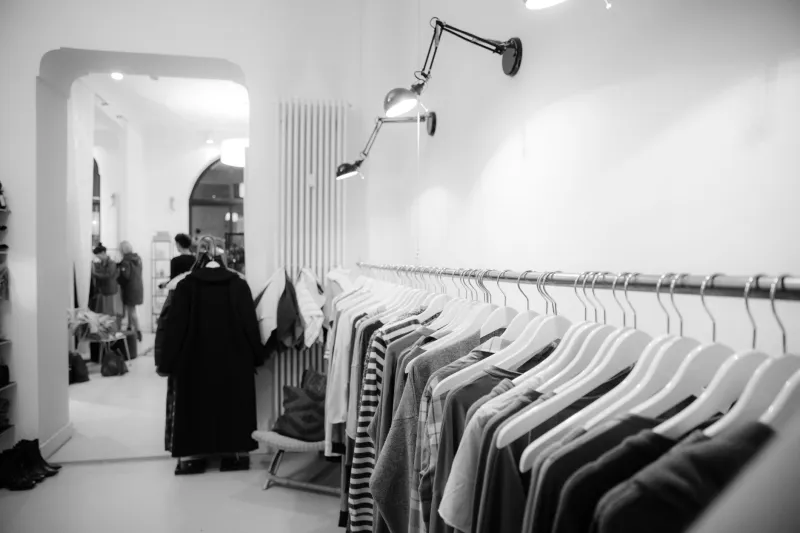
There is a particular kind of confidence that announces itself without effort. It is the confidence of the woman who wears the same impeccably cut cashmere coat to both a gallery opening and a Saturday morning in the market — and looks, in both settings, entirely correct. It is the ease of the man whose wardrobe, though modest in volume, never fails him. This is not the confidence born of abundance. It is the confidence born of knowing, with absolute certainty, exactly what one owns — and precisely why.
Across America's most discerning social circles, a considered philosophy is reshaping the relationship between personal style and material accumulation. The curated wardrobe — built not through relentless acquisition but through strategic, even ruthless, subtraction — has become the quiet hallmark of those who understand that true elegance is, at its core, an act of discipline.
The Tyranny of the Full Closet
For decades, fashion culture rewarded volume. Seasonal hauls, trend cycles measured in weeks rather than years, and the seductive logic of the sale rack conspired to fill American closets with garments worn once, or never. Even among the affluent, the wardrobe became less a curated expression of self and more a record of impulse.
The reaction among the truly sophisticated has been decisive. Those who once measured style by range now measure it by depth. A closet containing forty pieces, each chosen with deliberate intention, is no longer seen as a limitation — it is recognized as an achievement. The discipline required to resist the unnecessary is, in its own way, as demanding as any creative act.
"The moment I stopped buying and started editing, everything changed," observes a prominent New York-based interior architect whose personal style is as studied as her professional work. "I realized I had been dressing for possibility — for who I might be, in some imagined future. The curated wardrobe forced me to dress for who I actually am."
Investment Dressing as Intellectual Exercise
The philosophical underpinning of the curated wardrobe is straightforward, if not always easy to practice: acquire fewer things, but acquire them at the highest possible level of quality. The investment piece — the Brioni suit, the Loro Piana overcoat, the Hermès belt worn daily for fifteen years — is not merely a financial calculation. It is a statement of values.
When a garment is expensive enough, beautiful enough, and well-constructed enough to last decades, it changes the wearer's relationship to it entirely. One does not discard a navy blazer from a storied Neapolitan tailor because the season has shifted. One learns, instead, to style it differently — to allow the piece itself to anchor an evolving aesthetic rather than chasing each new directive from the runway.
This approach demands a different kind of engagement with fashion. Rather than consuming collections passively, the sophisticated dresser approaches each acquisition as a curator approaches a potential work for the collection: with patience, with discernment, and with a clear understanding of what already exists and what is genuinely missing.
The practical result is a wardrobe in which every piece earns its place. Redundancy is eliminated. Aspiration is replaced by clarity. And the daily act of dressing — often experienced as a source of anxiety in a wardrobe overwhelmed by choice — becomes something closer to pleasure.
The Psychology of Restraint
Behavioral economists have long understood that an excess of options diminishes satisfaction rather than enhancing it. The paradox of choice — the disorienting effect of too many possibilities — is nowhere more apparent than in the overfull closet. The curated wardrobe sidesteps this entirely.
When one owns thirty pieces rather than three hundred, each decision carries weight and meaning. The deliberate limitations imposed by a restrained wardrobe do not diminish creative expression; they concentrate it. Constraints, as any artist will confirm, have a remarkable tendency to produce clarity.
There is also a psychological dimension to the investment piece that transcends the practical. A garment of genuine quality, worn repeatedly and maintained with care, develops a kind of history. It accrues meaning. The silk blouse purchased in Paris on a significant occasion, the leather bag that has accompanied its owner through two decades of professional life — these objects carry a weight of personal narrative that the disposable purchase can never achieve.
In this sense, the curated wardrobe is not merely a style philosophy. It is a form of autobiography.
Building the Foundation: What Belongs and What Does Not
For those drawn to this approach, the process of building a curated wardrobe begins not with acquisition but with excavation. The first task is an honest assessment of what already exists — not only whether each piece is beautiful or well-made, but whether it is genuinely worn, genuinely loved, and genuinely expressive of who one is today.
What remains after this process of subtraction becomes the foundation. The gaps that emerge — not the gaps invented by trend forecasters, but the genuine absences that make dressing difficult — are the only legitimate targets for new acquisition.
The most sophisticated practitioners of this approach speak of a wardrobe architecture: a structural logic in which each piece relates meaningfully to every other. Neutral foundations — the perfectly proportioned trouser, the white shirt cut to one's precise specifications, the unlined blazer in a weight that works across seasons — provide the grammar. A small number of more expressive pieces provide the vocabulary. The result is a system in which everything works with everything else, and nothing is ever stranded without context.
This is the wardrobe as a considered collection rather than an accumulation. And like any great collection, it rewards attention, patience, and the willingness to wait for precisely the right thing rather than settling for the merely available.
The Signature as the Summit
The ultimate aspiration of the curated wardrobe is something rarer still: the signature. The individual whose personal style is so consistent, so considered, and so entirely their own that it becomes recognizable — even iconic — across decades. Think of the late Karl Lagerfeld's immovable uniform, or the late Carolyn Bessette-Kennedy's architectural minimalism. These were not wardrobes assembled by chance. They were the result of profound self-knowledge, translated into cloth and cut.
The signature is not available for purchase. It cannot be acquired through any single investment piece, however magnificent. It emerges, slowly and organically, from the sustained practice of dressing with intention — from the accumulated decisions of someone who has decided, once and for all, to stop dressing for possibility and to dress, instead, for themselves.
In a culture still largely organized around the premise that more is more, this is a genuinely radical act. And among those who have committed to it fully, there is a particular satisfaction — quiet, private, and entirely their own — in knowing that their wardrobe, like their taste, is exactly sufficient. No more, and no less.