Beyond the Destination: How America's Most Discerning Travelers Are Elevating the Journey Itself
There was a time, not so long ago, when the measure of a remarkable trip was the photograph taken at its end — a landmark framed perfectly, a table secured at the impossible restaurant, a suite with the coveted view. Travel, for the aspirationally minded, was a performance as much as a pleasure. But among those who have long since exhausted the conventional hierarchy of prestige destinations, a quieter and considerably more sophisticated philosophy is taking hold.
America's most accomplished travelers — those for whom access has never been the obstacle — are turning their attention inward. They are asking not merely where they go, but how they move through the world, and why. The answers are reshaping luxury travel in ways that no star rating or concierge ranking can fully capture.
The Shift From Trophy to Texture
The impulse to document and broadcast travel has, for much of the past decade, exerted a peculiar gravitational pull on even the most private individuals. Yet within circles where wealth affords genuine choice, a deliberate withdrawal from that culture is well underway. The most telling sign of this shift is not the destination chosen, but the absence of any announcement surrounding it.
Bespoke travel designers — a category distinct from the traditional luxury travel agent — report that their most exacting clients are now arriving with something more nuanced than a wish list. They arrive with a disposition. They speak less about five-star properties and more about the quality of light in a particular valley at a particular hour, about wanting to understand the provenance of a regional cuisine from the hands that produce it, about traveling slowly enough to allow serendipity its proper role.
This is not minimalism for its own sake. It is the recognition that the rarest commodity in contemporary life is not access — it is meaning.
Private Access as the New Prestige
For those operating at the highest levels of affluent travel, the concept of "exclusive" has been thoroughly reexamined. The velvet rope and the VIP designation have grown familiar enough to feel almost ordinary. What commands genuine admiration now is access of a different order entirely — the kind that cannot be purchased through a premium membership tier.
Consider the traveler who arranges a private evening with a master glassblower on the island of Murano, not as a scheduled demonstration but as an extended conversation between equals. Or the family that commissions a week-long journey through the American Southwest guided by a cultural historian with deep roots in the Indigenous communities whose lands they traverse. These experiences share a common quality: they are irreproducible, non-transferable, and entirely unsuited to a social media caption.
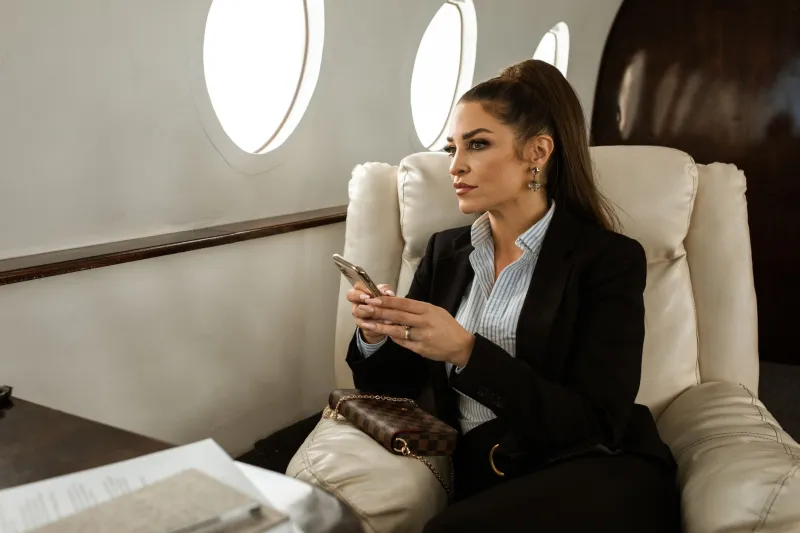
Private aviation has long been a fixture of this world, but even its role is evolving. The emphasis is shifting from the mere convenience of a private terminal to the curation of the airborne hours themselves — curated reading selections, onboard culinary programs developed in collaboration with chefs at the destination, and arrival schedules calibrated not to business efficiency but to the rhythms of the place being visited.
The Luxury of Traveling Without an Audience
Perhaps the most counterintuitive development in this evolution is the conscious decision to travel without documentation — or at the very least, without dissemination. Among the most refined travelers of this generation, the phone remains in the bag. The experience is absorbed rather than archived.
This is not technophobia. It is a form of discernment. When every waking moment of a journey is filtered through the question of how it will appear to others, the traveler forfeits something essential: the unmediated encounter with a place and with oneself within it. The growing preference for this kind of unwitnessed travel reflects a deeper understanding of what luxury actually provides at its highest expression — not envy, but enrichment.
Travel designers who work with this clientele describe a notable change in the conversations they are having. Clients are requesting journals over itineraries. They are asking for time built into each day that is entirely unscheduled. They are, in the language of one prominent planner based in New York, "learning to be tourists of their own inner lives."
Intentional Planning as a Form of Connoisseurship
The infrastructure supporting this philosophy is itself a study in refinement. A new generation of independent travel architects — many of them former diplomats, academics, or cultural figures with deep regional expertise — are offering something the traditional luxury agency cannot: genuine intellectual partnership in the design of a journey.
These collaborations can take months. A single two-week itinerary might involve correspondence with local historians, coordination with private landowners, and the careful sequencing of experiences to build toward something cumulative rather than merely impressive. The traveler is not handed a program; they are invited into a process.
The financial investment is considerable, but those who have experienced this approach tend to describe it in terms that have little to do with money. They speak of trips that changed how they think, of encounters that produced lasting friendships, of landscapes that recalibrated their sense of what matters.
Returning Changed, Not Simply Rested
What distinguishes this emerging ethos from the wellness retreats and digital detoxes that preceded it is its ambition. This is not travel as recovery. It is travel as formation.
The most discerning American travelers are approaching their journeys the way their grandparents' generation once approached a great education — as something that should leave them demonstrably altered. More curious. More patient. More capable of sitting with complexity and uncertainty. The destination is almost incidental; it is the quality of attention brought to it that determines whether the experience rises to the level of the genuinely luxurious.
In this sense, the art of arrival has little to do with the moment the wheels touch down. It is the culmination of everything that has been considered, prepared, and ultimately released to chance — a philosophy as applicable to the journey through a foreign city as to the one through a well-examined life.