The Intimate Imperative: How America's Most Accomplished Hosts Are Mastering the Art of the Intentional No
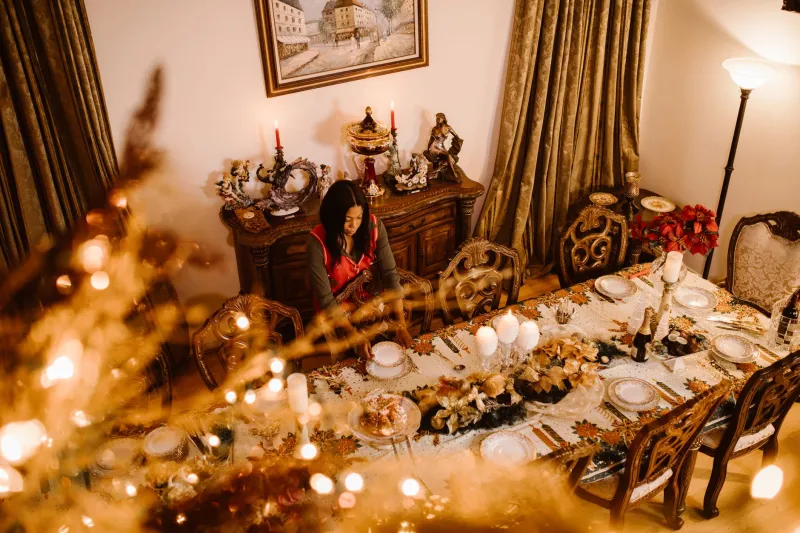
There is a particular kind of social courage required to send twelve invitations when you could have sent one hundred. It demands a clarity of vision that most people, even those with the resources to host lavishly, rarely summon. Yet among America's most genuinely accomplished entertainers — those whose homes have become the quiet centers of cultural and intellectual gravity — this discipline of restraint has become the defining hallmark of truly memorable hospitality.
The era of the spectacular is not over, precisely. Grand galas and sweeping charity events retain their place in the social calendar. But something more meaningful is emerging alongside them: a renewed reverence for the intimate gathering, where the architecture of the evening is built not on abundance, but on deliberate constraint.
When the Guest List Becomes the Statement
Ask any seasoned host in New York, Chicago, or the quieter corridors of Palm Beach what separates a forgettable evening from one that guests discuss for years afterward, and the answer rarely involves the caterer. It involves the room — not its dimensions, but its composition.
"The guest list is the first act of curation," observes one celebrated Manhattan hostess whose salon dinners have earned a near-mythic reputation among the city's literary and financial elite. "Every person you invite changes the chemistry of the entire evening. Add the wrong element and the whole thing shifts. That's why saying no — gracefully, warmly, but firmly — is actually an act of generosity toward the people you do invite."
This philosophy represents a significant departure from the social calculus of previous generations, where the size of an event often functioned as a proxy for its host's influence. Today's most discerning entertainers have largely abandoned that arithmetic. The prestige now lies not in how many people were present, but in how carefully each one was chosen — and what that selection communicates about the host's values, relationships, and aesthetic sensibility.
The Psychology of the Constrained Evening
There is genuine psychological science underpinning what sophisticated hosts have long understood intuitively. Research in social dynamics consistently demonstrates that human beings form deeper connections in smaller groups, where conversation flows more naturally and the pressure to perform for a crowd dissolves. When an individual receives an invitation to a gathering of ten rather than one hundred, the implicit message is unmistakable: you were specifically wanted here.
That specificity carries an emotional weight that no grand gesture can replicate. It transforms the act of attending from a social obligation into something that feels genuinely personal — an acknowledgment of a particular relationship, a particular mind, a particular presence.
The most thoughtful hosts understand this calculus with precision. They design their evenings around a central tension: intimate enough that every guest feels essential, yet varied enough that the conversation takes unexpected turns. Achieving this balance requires the kind of editorial judgment that is, frankly, difficult to acquire and impossible to fake.
Constraint as Creative Discipline
The parallel to artistic practice is not incidental. The greatest creative works are rarely defined by their excess — they are shaped by their constraints. The sonnet's fourteen lines. The haiku's syllabic boundaries. The chef's tasting menu, where limitation becomes the engine of innovation. The same principle applies, with equal force, to the art of entertaining.
When a host commits to a table of eight rather than a room of eighty, every element of the evening must earn its place. The floral arrangement that might be lost in a vast ballroom becomes a conversation piece at a smaller table. The wine selection, chosen with specific guests in mind, tells a story that a generic open bar cannot. Even the silence between courses acquires meaning when the room is small enough to hold it.
Some of the most celebrated private entertainers in cities like San Francisco, Boston, and Washington, D.C., have spoken openly about the creative liberation that comes with embracing limitation. When the goal is not to impress a crowd but to serve a conversation, the entire logic of the evening shifts — and with it, the host's relationship to every decision, from the menu to the music to the precise moment the evening should end.
The Grace of the Considered Decline
Of course, none of this is possible without the willingness to deliver difficult answers to people who might reasonably expect to be included. This is, for many hosts, the hardest part of the practice — and the part most rarely discussed in polite company.
The graceful decline is its own art form. It requires honesty without injury, warmth without false promise, and a certain quiet confidence in the host's own vision. Those who execute it well have learned to frame the constraint not as a rejection but as a reflection of the evening's specific character — "this one is a small working dinner" or "we're keeping it to people who know each other well" — language that honors the excluded party while preserving the integrity of the gathering.
What distinguishes the truly accomplished host is the understanding that a well-delivered no is, in the long run, a form of respect. It signals that the invitation, when it does arrive, means something. That it was not distributed casually or out of obligation, but extended with genuine intention.
The Invitation as Artifact
In an age when digital communications have made the act of invitation nearly frictionless, the most sophisticated entertainers are also reconsidering the physical and ceremonial weight of the invitation itself. Handwritten notes on engraved cards, delivered by messenger to a select few, carry a communicative power that no digital equivalent can approximate. They announce, before the evening has begun, that what follows has been considered — that the host has invested time, care, and creative attention in something that matters to them.
This attention to the artifact of invitation is inseparable from the broader philosophy of the intimate gathering. It is all of a piece: the shortened guest list, the considered menu, the deliberate pacing of the evening, and the physical token that summons guests to something they understand, instinctively, to be rare.
The Lasting Impression of Less
What the most refined entertainers in America have come to understand — and what the broader culture is slowly absorbing — is that memorability is not a function of scale. The evenings that guests carry with them for years, that they reference in conversation and return to in memory, are almost never the largest ones they attended. They are the evenings where they felt genuinely seen, where the conversation surprised them, where the room felt as though it had been assembled specifically and impossibly for them.
Creating that feeling requires the courage to work within constraints — to say no to volume in order to say yes, with full conviction, to depth. It is, in the end, the most generous thing a host can offer: not an event, but an experience. Not a gathering, but a gift.