Living Among Masterpieces: The Rise of the Private Museum Home
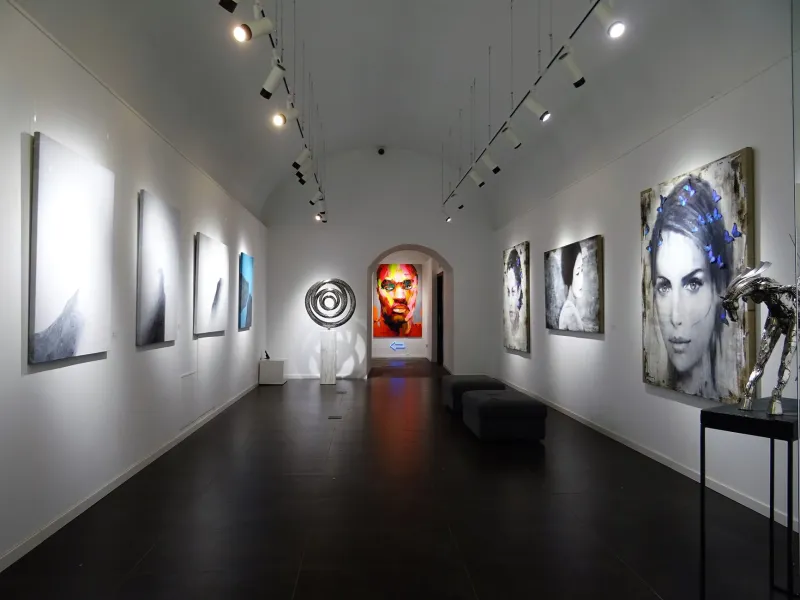
There is a particular kind of silence that exists inside a well-considered art space — not the silence of absence, but of profound attention. It is the silence of a room that has been designed to make you stop, to slow the rhythm of your breathing, and to look, truly look, at what hangs before you. For a growing number of America's most culturally attuned collectors, that silence no longer belongs exclusively to public institutions. It lives, instead, behind the front doors of their own homes.
Across the country — from the hills of Bel Air to the brownstone corridors of Manhattan's Upper East Side, from the sprawling estates of Palm Beach to the modernist compounds of the Pacific Northwest — ultra-high-net-worth individuals are commissioning private museum spaces of extraordinary ambition. These are not trophy rooms adorned with recognizable names. They are thoughtfully constructed environments, built to the exacting standards of the world's finest cultural institutions, and shaped by a philosophy of collection that prioritizes meaning over spectacle.
Beyond the Gallery Wall
The distinction between a well-decorated home and a private museum is not merely one of scale. It is one of intention. Where the former arranges objects for visual pleasure, the latter constructs a narrative — a curated argument about beauty, history, and the particular sensibility of the person who assembled it.
"The clients who come to us with this vision are not simply buying art," explains one prominent New York-based private art consultant who works exclusively with collectors at the highest tier of the market. "They are building a conversation between objects, between periods, between ideas. The physical space is the syntax of that conversation."
To that end, the architectural requirements of these projects rival those of any public institution. Museum-grade HVAC systems maintain precise humidity and temperature ranges. UV-filtering glazing protects works on paper and canvas from light degradation. Purpose-built lighting rigs — designed by the same specialists who illuminate galleries at the Whitney or the Art Institute of Chicago — are installed to render each work under conditions its creator might have considered ideal. In some residences, dedicated conservation studios have been incorporated directly into the floor plan, allowing works to be treated and restored without ever leaving the property.
The Curator in Residence
Perhaps the most telling indicator of this movement's seriousness is the emergence of the residential curator as a professional role. Once the exclusive province of major institutions, the working curator now finds employment within private households of sufficient cultural ambition.
These individuals — typically trained at prestigious programs and often with prior institutional experience — are responsible not merely for the care of existing collections, but for their ongoing intellectual development. They research provenance, advise on acquisitions, design rotating display programs, and, in some cases, produce private catalogues that document the collection's evolution with the rigor of a museum publication.
"What we are seeing is a genuine democratization of the curatorial impulse," observes one Los Angeles-based art advisor who has helped establish several such collections on the West Coast. "Though 'democratization' is perhaps not the right word when we are discussing resources at this level. What I mean is that the sensibility — the desire to engage with a collection as a living, breathing intellectual project — is no longer confined to the institutional world."
Rotating displays are central to this philosophy. Unlike the static arrangements that characterize most private collections, these museum-homes operate on exhibition cycles, with works moved in and out of primary display areas on a seasonal or thematic basis. Storage facilities within the residence — themselves climate-controlled and professionally managed — hold works not currently on view, ensuring the collection remains dynamic and the living experience of the home continues to evolve.
Identity, Expressed in Linen and Light
For those who have undertaken these projects, the motivations extend well beyond aesthetics. There is, in the construction of a private museum, an act of profound self-definition. The collection becomes, in effect, a three-dimensional autobiography — a record of one's intellectual preoccupations, emotional responses, and long-cultivated sense of beauty.
"Every acquisition I have made tells you something about a particular moment in my life," reflects one East Coast collector who has spent three decades assembling a collection that now occupies a purpose-built wing of his Connecticut estate. "Taken together, they tell you something about who I am. The space I have created allows those objects to speak to one another in a way that a commercial gallery or a public museum never could, because the logic of the arrangement is entirely personal."
This deeply personal dimension distinguishes the private museum from its public counterpart in ways that are not incidental. Public institutions must serve broad audiences, balance competing scholarly and commercial interests, and navigate the complex politics of acquisition and deaccession. The private collector faces no such constraints. The result, at its finest, is a collection of singular coherence — an aesthetic universe governed by a single, consistent intelligence.
Legacy by Design
Not all of these spaces are purely private. A number of collectors have begun to open their homes, on a carefully limited basis, to scholars, students, and fellow collectors — creating intimate encounters with art that no public institution could replicate. These are not tours in any conventional sense; they are, rather, the kind of privileged access that has always characterized the most meaningful cultural transmission, the passing of knowledge and sensibility between individuals of shared devotion.
The question of legacy weighs heavily on many collectors at this level. Several have established formal foundations to ensure their collections remain intact after their lifetimes, with the private museum space itself preserved as part of the bequest. Others are working with legal and cultural advisors to negotiate arrangements with public institutions — loans, promised gifts, eventual transfers — that will allow their collections to reach broader audiences while maintaining, for now, the intimacy that defines the private museum experience.
"What I am building," says one collector simply, "is not a house with art in it. It is an argument about what matters, rendered in paint and stone and light. I intend it to outlast me."
In that aspiration — earnest, ambitious, and quietly magnificent — lies the true architecture of taste.