Less, Deliberately: The Ultra-Wealthy Turn to Intentional Restraint as the New Measure of Taste
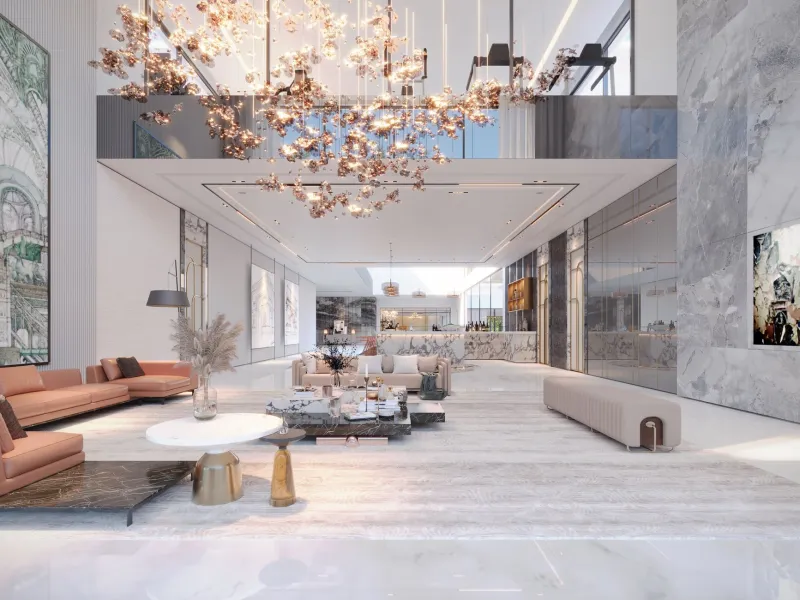
The Quiet Departure from More
For much of the late twentieth century, the language of American wealth was spoken in superlatives. The largest estate. The most expansive art collection. The greatest number of residences scattered across desirable zip codes from Malibu to Manhattan. Accumulation was the grammar of success, and excess its punctuation.
That grammar, it appears, is being quietly retired.
Across the country's most rarefied social strata — among established collectors, multigenerational wealth holders, and a new generation of discerning high-net-worth individuals — a deliberate turn toward minimalism is reshaping what it means to live well. This is not austerity, nor is it trend-chasing. It is something far more considered: a conscious philosophy of curation that treats restraint itself as the ultimate act of sophistication.
"The people who are truly secure in their position no longer feel the need to demonstrate it through volume," observes one New York-based interior designer whose client roster spans Park Avenue penthouses and Palm Beach estates. "They are editing. Ruthlessly, beautifully editing."
The Art of the Edited Collection
Nowhere is this movement more visible than in the world of fine art collecting. Where previous decades saw the rise of the trophy collector — assembling vast holdings across multiple genres, filling warehouses and secondary residences with acquisitions that outpaced any meaningful engagement — today's most respected collectors are moving in the opposite direction.
The new aspiration is depth over breadth. A single room containing five works of extraordinary resonance, each chosen with surgical deliberateness, carries more cultural weight in contemporary collecting circles than a sprawling gallery of forty pieces assembled for their market value alone. Curators and advisors report an increasing number of clients who are actively deaccessioning — selling or donating significant portions of their holdings — not from financial necessity, but from a desire for what one prominent collector described as "visual breathing room."
This approach extends beyond the walls of the private home. At major American art fairs, the booths that attract the most serious attention are frequently those presenting fewer works, displayed with generous spacing and deliberate intention. The message is unmistakable: confidence requires no clutter.
Fashion's New Vocabulary
The shift is equally pronounced in the wardrobes of America's most style-conscious wealthy. The era of the overstuffed closet — multiple walk-in rooms cataloguing decades of seasonal acquisitions — is giving way to something more austere and considerably more refined.
The concept of the considered wardrobe, built around exceptional individual pieces rather than seasonal abundance, has gained remarkable currency among those who once measured their fashion engagement in trunk shows attended and runway pieces acquired. Today, the conversation has pivoted. What remains after rigorous editing? Which pieces are genuinely irreplaceable? Which silhouettes transcend the seasonal and speak to something more enduring?
Luxury fashion houses with the longest histories and the quietest marketing have found themselves particularly well-positioned for this moment. The bespoke suit from a Savile Row tailor with a New York fitting room. The single, extraordinary handbag that requires a waiting period measured in years rather than weeks. These objects derive their power precisely from their singularity — from the fact that they represent a choice made, not a collection amassed.
Real Estate: The Case for One Exceptional Home
Perhaps the most striking expression of this philosophy appears in real estate decisions. For decades, the portfolio approach to property — accumulating residences in ski destinations, coastal retreats, urban centers, and European capitals — served as a reliable index of financial achievement. The question was never which home, but how many.
A growing contingent of ultra-high-net-worth Americans is now asking a different question entirely: what if one residence, configured with absolute perfection, rendered the others unnecessary?
This is not universally true — private aviation and the seamless mechanics of managing multiple properties ensure that the multi-residence lifestyle remains deeply embedded in affluent American culture. But the conversation has shifted. Architecture and interior design firms report increasing requests for projects that prioritize depth of investment in a single property over the maintenance of a scattered portfolio. The goal is a home so completely realized, so precisely attuned to its owner's sensibility, that it becomes genuinely difficult to leave.
The result, when executed well, is a kind of domestic masterpiece — a space that reflects not what its owner could afford, but who they actually are.
Experiences, Curated Rather Than Collected
The minimalist impulse has reached the experiential dimension of affluent life as well. Where the aspirational travel itinerary once demanded the greatest number of destinations compressed into the smallest window of time, today's most thoughtful travelers are embracing a radically different approach.
The extended stay. The single destination explored with genuine intimacy rather than the camera-ready efficiency of a checklist. The private villa returned to year after year, its rhythms and particular beauty absorbed across seasons rather than sampled in a single weekend. These choices reflect a maturity of appetite — an understanding that depth of experience yields something that breadth, however impressive, simply cannot.
Event and experience designers catering to the upper echelons of the market confirm this observation. The most coveted gatherings are now smaller, more deliberately composed affairs — intimate enough for genuine conversation, curated with sufficient care that every element feels intentional. The era of the spectacular for its own sake is quietly yielding to the era of the meaningful.
What Restraint Actually Requires
It would be a mistake to interpret this movement as simplicity. True minimalism, practiced at the highest levels of taste and financial capacity, is among the most demanding aesthetic disciplines imaginable. It requires, above all, certainty — the confidence to choose one thing rather than many, knowing that the choice itself will be examined.
It requires knowledge deep enough to distinguish the genuinely exceptional from the merely expensive. It demands the willingness to wait, to decline, to pass on the available in favor of the precisely right. These are capacities that accumulate slowly, over years of genuine engagement with beauty, craft, and cultural history.
In this sense, the shift toward intentional restraint is not a rejection of luxury but its most refined expression. When less is chosen deliberately, with full awareness of what has been set aside, it becomes something far more powerful than more could ever be. It becomes a statement of complete authority over one's own aesthetic world — and that, in the end, is what the most sophisticated form of wealth has always been about.