Silence as Status: The Quiet Revolution of Unmarked Luxury Among America's Wealthiest
There is a particular kind of power in being unrecognizable. Not invisible, precisely — but deliberately, carefully unmarked. Walk through the lobby of a certain Manhattan private members' club on any given Tuesday evening, and you will observe something quietly extraordinary: a room full of exceptionally well-dressed men and women wearing almost nothing that can be immediately identified. No interlocking initials. No embossed monograms visible from across the room. No signature hardware catching the chandelier light in ways designed to be noticed.
What you will find, if you know where to look, is something far more compelling — and considerably harder to acquire.
The Backlash Against the Billboard
For a generation, conspicuous consumption operated on a simple visual grammar: the louder the logo, the clearer the message. Luxury houses built empires on the recognizability of their insignia, and the aspirational middle market absorbed those symbols with genuine enthusiasm. But somewhere in the space between the financial crisis of 2008 and the social media saturation of the 2010s, America's true upper echelon began to quietly, almost imperceptibly, step away from that conversation.
"The logo became democratized," explains one New York-based luxury advisor who counts among her clients several members of the Forbes 400. "When the same monogram appears on a $450 wallet and a $4,500 bag, it loses its function as a signal entirely. My clients don't want to be grouped into a category. They want to be understood by the right people — and completely overlooked by everyone else."
This phenomenon, which scholars of consumer behavior sometimes call "stealth wealth" and which the broader cultural conversation absorbed rather noisily during 2023, is in fact not new among the genuinely affluent. What is new is its acceleration, its intentionality, and its expanding influence across every category of luxury consumption.
The Grammar of Quiet Goods
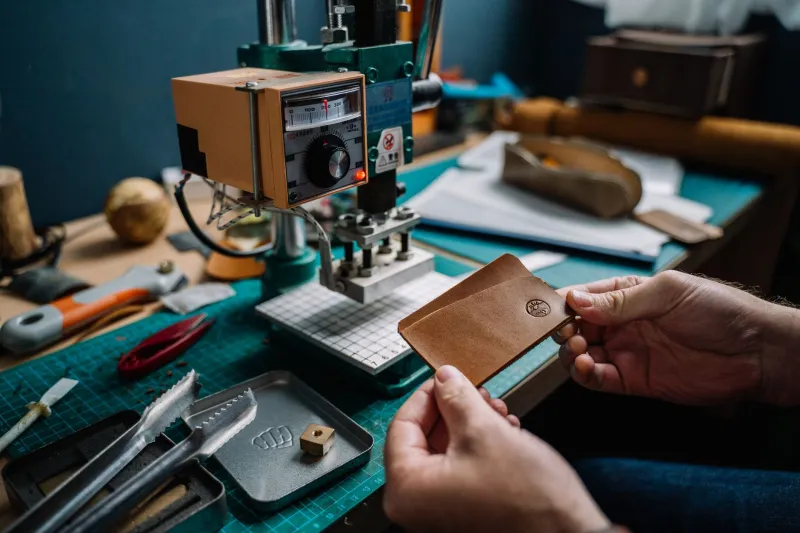
In leather goods, the shift is perhaps most immediately legible. The ateliers generating the most significant excitement among America's ultra-high-net-worth clientele are, almost by definition, the ones most consumers have never heard of. Bespoke briefcases from small Florentine workshops with no social media presence. Wallets constructed from a single piece of hand-selected hide, stitched by one craftsman over the course of several days, bearing no external marking whatsoever beyond the quality of the leather itself. Handbags commissioned directly from artisans who maintain waiting lists measured in years, not months.
These objects communicate nothing to the uninitiated. To those who recognize them — the weight of the leather, the particular hand of a specific tannery, the almost imperceptible details of construction — they communicate everything.
The same logic has migrated into menswear, where the most coveted garments are increasingly those with labels sewn inside collars that most people will never read. Bespoke tailoring from houses on Savile Row and their American counterparts has surged among a clientele that could easily afford the most recognizable ready-to-wear offerings in existence — and has chosen, quite deliberately, to invest instead in something that fits better and announces itself to no one.
Wine, Watches, and the Connoisseur's Advantage
Perhaps nowhere is this cultural turn more elegantly expressed than at the table. The unlabeled wine — or more precisely, the wine whose label means nothing to the uninformed guest but everything to the informed one — has become a quiet signifier of genuine taste. Micro-production Burgundies from domaines with annual outputs measured in the hundreds of cases. Orange wines from obscure Georgian producers. California cult bottles that never appear on restaurant lists because their allocations are consumed entirely by a private mailing list of perhaps two hundred people nationwide.
"Pouring something that requires explanation is the new flex," observes one Los Angeles-based sommelier who advises private collectors. "If your guest doesn't know what they're drinking, that's information. If they do know — if their eyes change when they see the bottle — that's a connection. That's a conversation. That's worth infinitely more than impressing someone with a label they recognize from a duty-free shop."
In horology, the same sensibility has propelled a generation of collectors away from the most recognized names in watchmaking toward independent houses and complications so specific that only a fellow enthusiast would register them. The watch that prompts another collector to lean forward and ask, quietly, "Is that a Dufour?" — that is the watch worth wearing.
The Psychology of Selective Visibility
Why, precisely, does this appeal so powerfully to those who could afford to announce themselves loudly? The answer, luxury psychologists suggest, is rooted in something deeper than mere contrarianism.
"There is a profound satisfaction in being recognized by your actual peers rather than by the general public," notes one consumer behavior researcher whose work focuses on the ultra-affluent segment. "When status symbols become widely accessible — even if only aspirationally — they stop functioning as peer recognition tools and start functioning as noise. The people at the very top of the wealth distribution are not interested in signaling to people who don't share their context. They're interested in finding each other."
This is, at its core, a form of social filtering. The unmarked bag, the unlabeled wine, the bespoke suit that fits in a way no off-the-rack garment ever could — these are not merely aesthetic choices. They are a kind of private language, spoken fluently only by those who have spent years, and considerable resources, learning its vocabulary.
What Comes Next
The irony, of course, is that writing about stealth wealth at all risks accelerating its own obsolescence. The moment a sensibility becomes legible to the broader culture, the most discerning practitioners tend to move on. What can be said with confidence is that the underlying impulse — the desire for quality that transcends recognition, for belonging that requires genuine knowledge rather than mere purchasing power — is not a trend subject to the ordinary cycles of fashion.
It is, rather, a permanent feature of how the truly affluent have always related to luxury. The logo era, in retrospect, may come to be understood as the anomaly: a brief, loud interlude in a much longer, quieter story about connoisseurship, discretion, and the enduring appeal of things that do not need to explain themselves.
The most luxurious objects in any room, it turns out, are often the ones you cannot quite identify — which means, of course, that you already know exactly what they are.