The Art of Keeping: Why America's Most Refined Collectors Are Choosing Privacy Over Prestige
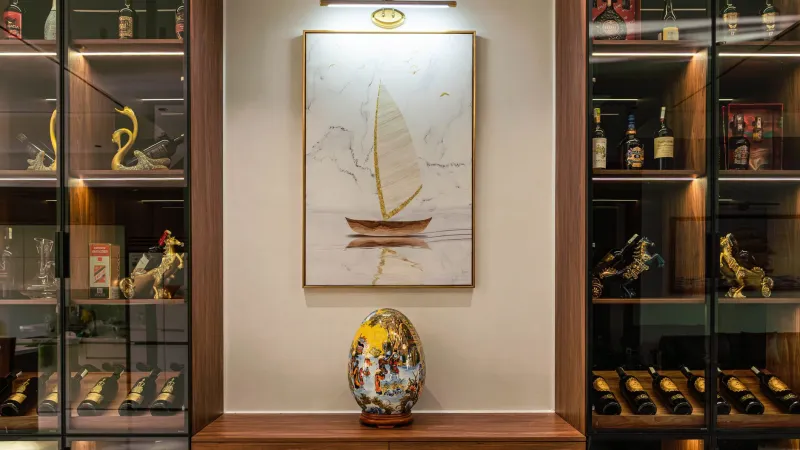
For generations, the grandest American collections have announced themselves. Soaring entrance halls hung with museum-caliber canvases. Purpose-built galleries appended to Connecticut estates. Climate-controlled vaults given the architectural treatment of a sacred nave. The implicit logic was straightforward: extraordinary objects deserve extraordinary stages, and those stages, in turn, reflect the extraordinary stature of their owners.
That logic, quietly but unmistakably, is being dismantled.
Across the country's most discerning collecting circles — from the private residences of Manhattan's Upper East Side to the understated coastal retreats of Nantucket and Marin County — a new sensibility is taking hold. The finest possessions are being withdrawn from view. Not hidden, precisely, but held closer. Experienced differently. And in that deliberate intimacy, something unexpected has emerged: restraint itself has become the most eloquent statement a collector can make.
From Exhibition to Encounter
The distinction may seem subtle, but those who move within serious collecting culture understand it immediately. There is a fundamental difference between displaying an object and encountering it.
Display implies an audience. It presupposes a viewer whose approval, admiration, or even envy lends the object a portion of its meaning. The gallery wall, the pedestal, the carefully angled museum light — these are all instruments of communication directed outward. They say: look at this, and by extension, look at me.
Encounter, by contrast, is a private transaction. It takes place in a study at dawn, when a collector pauses before a small Morandi still life positioned at eye level on a simple shelf, a cup of coffee in hand and no one else in the room. It happens when a particularly fine piece of Japanese lacquerware is held, turned, considered — not for the benefit of weekend guests but simply because the act of holding it produces a quality of attention that nothing else quite replicates.
"There is a moment," says one prominent New York-based art advisor who works exclusively with private clients, "when a collector stops needing their collection to perform. That moment usually arrives after years of serious engagement. It's not disillusionment — it's arrival."
The Architecture of Intimacy
This philosophical shift is producing tangible changes in how collectors commission and configure their domestic spaces. Interior designers who specialize in high-end residential projects report a marked departure from the maximalist gallery aesthetic that dominated affluent interiors through much of the 1990s and 2000s.
Where clients once requested dedicated gallery corridors lined shoulder to shoulder with significant works, the requests arriving today are strikingly different. A single exceptional drawing, framed with obsessive precision, positioned in a morning room where its owner takes breakfast alone. A sculpture placed not in a formal foyer — where it would greet every visitor — but in a private sitting room accessible only to the household and its most intimate guests. Objects rotated seasonally, or even monthly, so that each piece receives its full moment of attention before yielding to the next.
"The homes I'm working on now are not trying to impress," notes one San Francisco-based designer whose client roster includes several prominent West Coast collectors. "They're trying to feel something. That's a completely different brief, and it produces completely different spaces."
The resulting interiors are, by conventional measures, quieter. Fewer objects. More considered placement. An almost meditative quality of negative space that allows each piece to breathe and to be genuinely seen — rather than competing for attention within a crowded visual field.
The Epistemology of the Unseen
There is a deeper intellectual current running beneath these aesthetic choices. America's most serious collectors are increasingly engaging with a set of questions that have preoccupied connoisseurs in other cultures — particularly in Japan — for centuries: What is the relationship between an object's visibility and its value? Does display enhance meaning, or does it gradually erode it? And what does it say about a collector's relationship to beauty when they choose to share it with the world versus when they choose to keep it entirely for themselves?
The Japanese concept of mono no aware — the bittersweet awareness of impermanence, often associated with the appreciation of beautiful things — offers one framework. The tea ceremony tradition, with its emphasis on singular, unhurried attention to objects of refined simplicity, offers another. These are not frameworks that American collecting culture has historically embraced with much enthusiasm. But something is shifting.
"I have clients who have spent decades building extraordinary collections," reflects one leading art advisor based in Chicago. "And the ones who have arrived at the deepest relationship with their objects are almost universally the ones who have stopped worrying about what anyone else thinks of what they own. The collection becomes genuinely theirs — not a performance of their taste, but an expression of who they actually are."
Selective Sharing as the New Generosity
It would be a misreading to interpret this movement as mere hoarding dressed in philosophical clothing. The collectors who embody this sensibility most fully are not, by and large, withdrawing entirely from the broader cultural conversation. Many remain active lenders to institutions, thoughtful participants in private study groups, and generous hosts of intimate viewings for scholars, curators, and fellow collectors whose engagement they trust.
What has changed is the terms of access. Rather than opening their collections broadly — through the semi-public mechanism of the trophy home tour, the charity auction preview, the magazine spread — they are choosing their audiences with the same care they bring to choosing objects. The viewing becomes an event of genuine significance precisely because it is not available to everyone.
In this sense, selective sharing has become its own form of cultural generosity. An invitation to encounter a collector's most prized possessions in their natural domestic habitat, without the mediation of institutional lighting or explanatory wall text, is increasingly understood within sophisticated circles as one of the more meaningful gestures a host can extend.
What Restraint Reveals
The broader cultural moment, saturated as it is with relentless visual noise and the compulsive publicness of social media, may be precisely what has made this counter-movement so resonant among those with the means and the discernment to pursue it.
When everything is displayed, nothing is truly seen. When every acquisition is announced, no object retains its mystery. The collectors who understand this — and who have the confidence to resist the gravitational pull of external validation — are arriving at something that, within the long history of connoisseurship, has always been the mark of the truly serious: a relationship with beauty that requires no audience to sustain it.
The finest collections, it turns out, may be the ones that the world will never fully see. And in that quiet keeping, something essential about the art of collecting — patient, private, profound — is being beautifully preserved.